
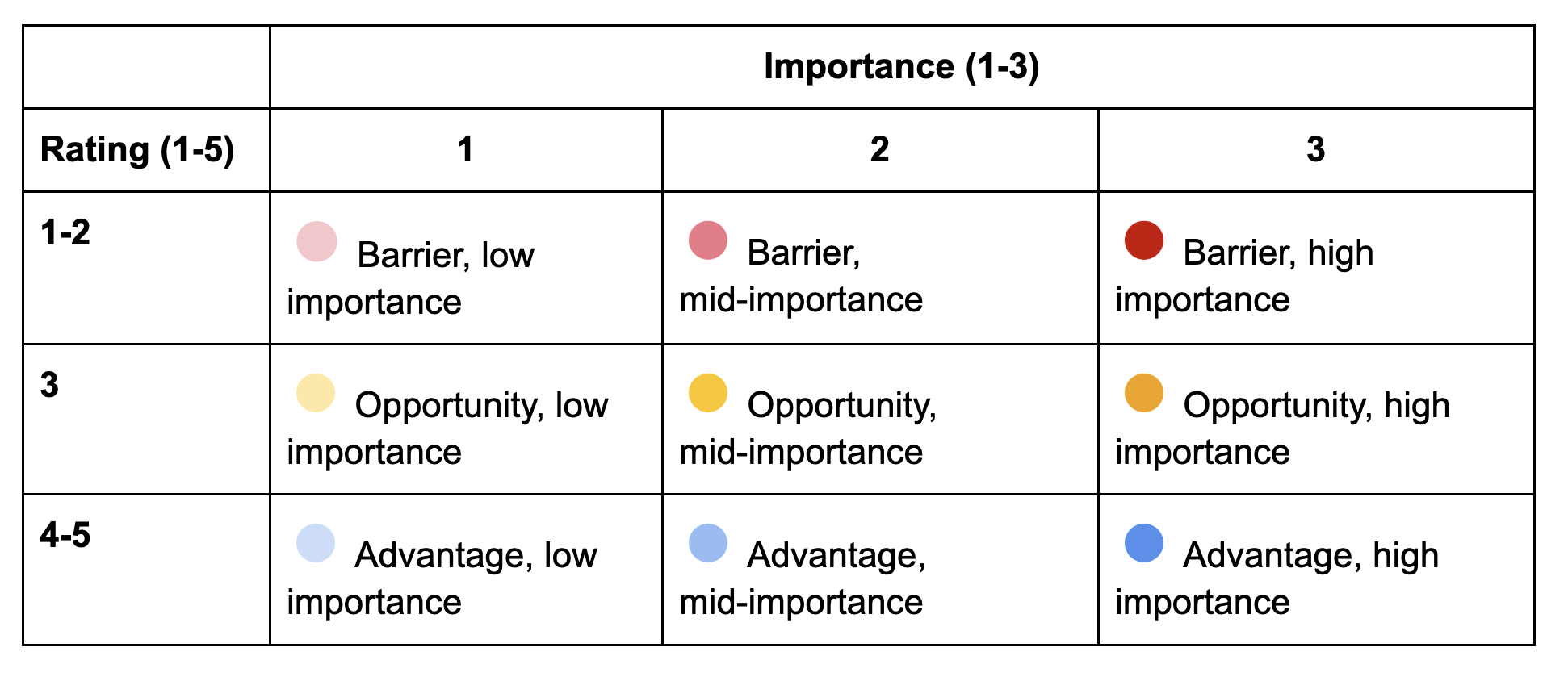
Scoring Legend
The IFASIS is designed to guide organizations through a structured process of reflection, dialogue, and evaluation. These instructions will walk you through what the tool is, why it’s valuable, and how to use it effectively as a team. You’ll learn how to identify your focus, gather the right people, score each item, and interpret results that highlight barriers, opportunities, and advantages. The steps also outline how much time to plan for, how to download your report, and where to go if you’d like to explore the full guide or request support.
The Inventory of Factors Affecting Successful Implementation and Sustainment (IFASIS) is a 27-item tool that helps organizations identify barriers, opportunities, and advantages to successfully implement and sustain a new intervention, program, or practice.
Note: The word “intervention” in the IFASIS can be used interchangeably with the program or evidence-based practice.
The IFASIS can be used towards:
Shared Understanding: Facilitate cross-team dialogue and consensus around what’s working and what needs attention.
Strategic Evaluation: Get a snapshot of organizational context—resources, leadership, readiness, fit, and more.
Informed Decision-Making: Identify what might influence your implementation efforts the most—and where to focus.
Program Improvement: Pinpoint organizational strengths and gaps so you can adapt, invest, or course correct.
Benchmarking Tool: Use IFASIS to track progress over time or across efforts.
1. Identify what you are trying to implement. What specific intervention, program, or service you're implementing.
2. Gather a team of three to seven individuals who have different roles within your organization (e.g., leadership, frontline staff) so that different perspectives can be considered. Meet in a quiet, comfortable place conducive to conversation. The IFASIS was designed to be a team led exercise.
3. Review, discuss, and assign a score to each item. Go one item at a time and discuss it as a team. Consensus needs to be reached for scoring. If you are hesitant between two ratings, choose the lower one. Rating (1–5): Reflects the status of an item within your organization. Importance (1–3): Indicates the importance of this item to your implementation effort.
4. Results. Items are categorized as barriers, opportunities, or advantages based on the “rating” and “importance” scores assigned. The colors and shading reflect this categorization.
5. Download your report that visually maps your results by status and importance assigned will be generated. The report will not be accessible once you close the browser.
6. Time. Plan to spend 30–45 minutes to complete IFASIS as a team. Results generate instantly.
The full IFASIS Guide includes detailed instructions for third party facilitation and administration of the IFASIS (both team-led and facilitated formats), example language for setting expectations with participants, confidentiality and recording best practices, and an in-depth explanation of the scoring system and how to interpret your results. It also outlines all 27 items across the IFASIS domains and includes sample visualizations to help you track progress over time.
📄 Download the Full IFASIS Guide
Need help using IFASIS? Contact us at info@cdias.org